About
I started Neurotype after hearing Harvard-trained psychiatrist Dr. K talk about how different minds respond to different meditation techniques. For someone with ADHD, sound or movement-based meditation can be much more effective than a long body scan, but meditation apps...
Key Features
- 200+ sessions across 11 conditions (ADHD, anxiety, sleep, panic, burnout, depression, etc.) with safety classes per session (standard, gated, panic-support, trauma-sensitive)
- Adaptive recommendations using weighted engagement signals - tracks which of 8 technique modalities (breathing, somatic, sound, visualization, mindfulness, movement, mantra, compassion) work best for each user
- Neuroadaptation milestones that frame progress in actual neuroscience terms with cited studies, not just streaks
- Module effectiveness tracking, wellbeing tracking, and technique effectiveness flower visualization showing your personal response to each modality over time
- Multiple sound options per session with intelligent sound selection that matches the protocol
- Live subtitles, during-session 'how do you feel' bar, and post-session ratings that feed back into the recommendation engine
- Skip button that jumps past the instruction straight to practice for returning users
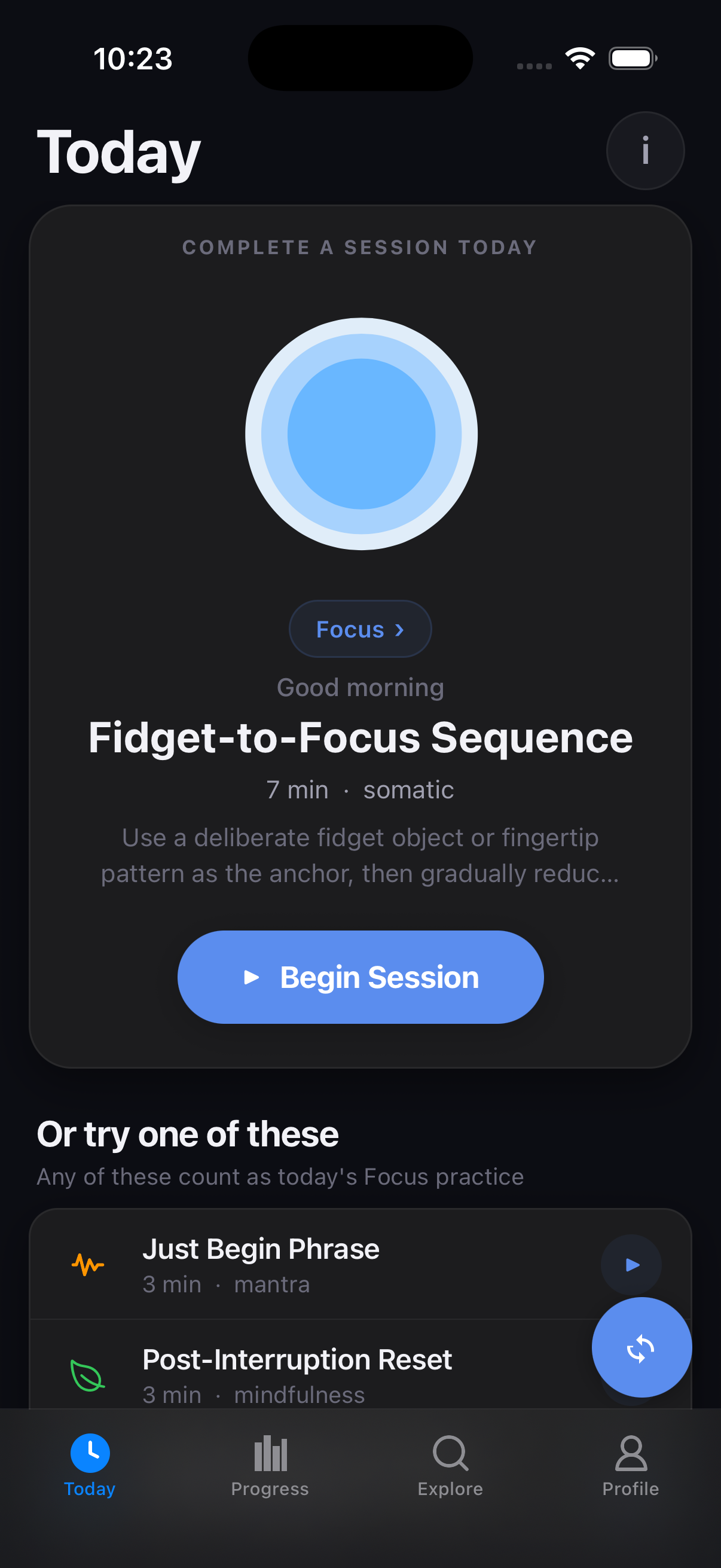
- 1 session a day architecture with a 'done for today' state and optional daily notifications - the scientifically accurate approach to meditation practice rather than binge-listening
- Share sessions and like sessions to build a personal library
- Sessions built on scientific literature with session shapes and protocols optimized for UX and scientific accuracy
- Multiple voice options per session
- Offline-first architecture with aggressive caching
Frontend & UI
Aside from simple features like multiple voice options and subtitles, almost every other feature is completely unique, so the frontend had to be intuitive and visually clean to avoid scaring users with the scientific depth underneath. Pulled design elements from Spotify, Apple Music, Netflix, Stress Watch, and Instagram for familiarity, then brought it to life with Lottie animations. The core interaction is built around a module selector - since each condition has its own recommendation system, you pick your module, get your daily session, do it, and you're done. The app finds the best session for that module so you don't have to browse. This whole flow is completely original and ties the design directly to how the science works underneath.
Backend & Infrastructure
• Supabase for auth (Google/Apple OAuth), database (PostgreSQL with RLS), and real-time sync • AI session generation pipeline: GPT Pro extracts techniques from research papers, maps them into 37 session formats across 20 internal protocol families, generates protocol-specific rules from difficulty, safety constraints, and evidence tiers, then compiles into custom XML with multi-level pause semantics and skip markers • Downstream audio stack converts XML session specs into TTS outputs via ElevenLabs and Inworld, matches approved sounds through a protocol-aware multi-stage LLM pipeline • Terminal-based mix/master chains built with sound engineers using FFmpeg and FabFilter for scalable production-grade audio output • Analytics-driven personalization using weighted engagement signals to adapt recommendations • Cloudflare R2 for audio storage and delivery • StoreKit 2 for subscriptions (free with limited modules, 21-day trial, $2.99/mo or $24.99/yr)
Type
Mobile App
Stack
Team
Uzay Poyraz
Everything
Efe P.
Sound Engineer
Media
Neurotype screenshot 1